
Knowledge Networking Portal for Sustainable & Responsible Tourism









 Trekking from Jhino Danda to Upper Sinuwa
Introduction: Trekking Jhino Danda to Upper Sinuwa – An Unforgettable Mountain Trail,
A fabulous trek from Jhino Danda (2,100m), right up to Upper Sinuwa at 2,360m, with surreal Himalayan scenery, thrilling adventure trekking, and diverse, rich local culture.
Key features and highlights of the Jhino Danda to Sinuwa trek:
- Panorama views of Annapurna South at 7,219m, Machapuchare at 6,993m, and Hiunchuli at 6,441m.
- Specific attention should be drawn to the following: - Dense rhododendron and pine forests with abundant Himalayan flora.
- Real Gurung villages with cultural experiences and warm hospitality.
- Moderate trekking suitable for beginners and intermediate trekkers.
- Developing case: - Good opportunities for photography, birdwatching, and nature exploration.
- Comfortable teahouse stays with local food, peaceful resting stops.
Meanwhile, this route from Jhino Danda (2,100m) to Upper Sinuwa (2,360m) offers a distinct Himalayan adventure that balances natural beauty, cultural immersion, and manageable trekking challenges. It is ideal for travelers seeking a moderate, less-crowded path that still delivers strong scenery and cultural reward. Along the way, you will wander through lush rhododendron woods, pine forests, and crystal-clear streams with awe-inspiring views of Annapurna South at 7,219 meters and Machapuchare at 6,993 meters. The trail threads through authentic Gurung villages, offering chances to encounter local traditions, warm hospitality, and everyday life. Further, this is also considered a very important part of the full Annapurna Base Camp and Ghorepani Poon Hill Trek because trekkers from all over the world come to experience a well-rounded mix of nature and culture with adventure. The path is mostly stone-paved, in addition to many small streams and wooden bridges, which add charm and natural beauty to the already sensational journey amidst the Himalayan landscape.
Here, accommodation comes in the form of traditional teahouses that serve authentic local meals such as dal bhat and momo. Travelers can also indulge in scenic photography, capturing sunrises over Dhaulagiri (8,167m) and expansive views of nearby peaks. Birdwatchers will especially enjoy spotting Himalayan Monal, woodpeckers, and other endemic species through the rhododendron and pine forests. In short, this trek borders on adventure, cultural exploration, and nature observation.
Here, a practical stop acclimatization before launching on the high altitudes. - Adventure trekking packages starting from USD 450, inclusive of guides and porters
Costing-wise, treks from Jhino Danda to Upper Sinuwa cost around USD 25 to 40 per day, which includes accommodation and meals. In case you hire guides as well as porters, then the total 5 to 6 day package will cost around USD 450. You can also customize your package as per your requirements, whether you are solo, coming as families, or even for specialized treks.
Bottom line: the Jhino Danda to Upper Sinuwa trek offers the best of adventure, culture, and nature combined. The trek passes through Chhomrong village, Riverside Settlements, Bhanuwa, Lower Sinuwa and finally Upper Sinuwa. As part of the trek, trekkers will enjoy views of the Himalayas, village experiences, and forest walks. The trek is ideal for nature enthusiasts and trekkers who wish to have a mid-range adventure experience amidst the Himalayas and can definitely not be missed when it comes to the Annapurna trek routes.

Trail Overview: Distance, Elevation Gain & Difficulty Level
A Himalayan trek from Jhino Danda (2,100m) to Upper Sinuwa (2,360m), including distance, elevation, difficulty level, and points of interest.
Trail information at a glance:
- Starting Point : Jhino Danda (2,100 m)
- Ending Point: Upper Sinuwa (2,360 m)
- Distance: approximately 8 km
- Elevation Gain: Approximately 260 m
- Difficulty: Moderate
- Trekking Time: 3-4 hours
- Key Highlights: Annapurna South - Machapuchare - Hiunchuli - Rhod
- Recommended Equipment: Walking sticks, trekking shoes, waterproof clothing, backpack allow
- Accommodation: Teahouses with Meals - Trekking Packages: $450+ (with guides and porters)
Actually, this trail starts from Jhino Danda at 2,100 meters and leads to Sinuwa at 2,360 meters, there are actually, two Sinuwas: Upper Sinuwa and Lower Sinuwa, covering an average distance of 8 kilometers, and it takes approximately 3-4 hours for the journey. The overall height gain would be 260 meters, making this trail moderately difficult, and it can be undertaken by people, whether they are beginner or have some experience of trekking before. The trail includes stone roads, streams, rhododendron, and pine forests, along with a few wooden bridges, through which one can experience the beauty of the Himalayas.
In fact, the difficulty level is moderate because there are moments when the trail becomes quite sharp. When you are getting close to Upper Sinuwa, there are hill sections that you will have to climb. You can be caught off guard by weather conditions if you are trekking during monsoons because the trail could be slippery. This is why you will need trekking boots, a walking stick, and water-resistant clothing.
Here, the trail provides spectacular views of the mountains of Annapurna-South (7,219m), Machapuchare (6,993m), and Hiunchuli (6,441m). The trail passes through small Gurung settlements where you can have some tea and snacks and experience some rich cultures too. Teahouses are available for resting and getting some rest, and food and acclimatization as well. In essence, the trek combines the elements of nature, some adventure, and cultures into just one single trekking experience. Trekkers should consider Upper Sinuwa a sensible, strategic point along a longer trek to Annapurna Base Camp. It is a place providing enticing places to rest, convenient teahouses, and breathtaking views of the Himalayas. With careful planning, preparation, and local support, a trekker can maximize safety alongside a truly enjoyable trekking adventure. Moreover, this alternative route can serve as a feasible way to acclimate to higher routes, seamlessly combining functionality alongside natural beauty.
Thus, overall, the trail from Jhino Danda to Upper Sinuwa is moderately difficult, interesting, and culturally rewarding. The trekker is presented with stunning views of the Himalayas, good trekking trails, and friendly village interactions. This trail forms an essential part of the Annapurna trekking circuit and is highly recommended for adventure-seekers, nature enthusiasts, as well as those interested in learning more about cultures.

How to Reach Jhino Danda – Starting Point Logistics
Here is information about reaching Jhino Danda (2,100m) and doing the Annapurna trek. Getting information about transportation and routes will make your start easier.
Key travel logistics and tips to reach Jhino Danda (2,100m) include:
- Kathmandu (1,400m) to Pokhara (827m) by domestic flight (~25 minutes) or tourist bus (~6–8 hours)
- Pokhara (827m) to Nayapul (1,070m) via jeep or local bus (~1.5–2 hours)
- Nayapul (1,070m) to Birethanti (1,070m) trekking start, passing through forests and riverside trails
- Jhino Danda (2,100m) reachable within 4–5 hours trekking from Nayapul/Birethanti
- Local teahouses available for rest and meals along the way
- Option to hire local guides or porters for luggage and trekking assistance
- Scenic viewpoints with Annapurna South (7,219m), Machapuchare (6,993m), and Hiunchuli (6,441m) visible along the trail
 Commencing the trek to Upper Sinuwa (2,360m) depends on a wise initial start from Jhino Danda (2,100m). To begin your journey, either take a plane from Kathmandu (1,400m) to Pokhara (827m) or travel by road. Pokhara can be reached easily in a bus or a private jeep to Nayapul (1,070m), which marks the entrance to the Annapurna Base Camp Trek. With prior preparations, there will be no time wasted to initiate your trek.
The road section from Pokhara (827m) to Nayapul (1,070 m) takes around 1.5 to 2 hours. At Nayapul, you can hire guides and/or porters for the carry of your gear, and short transfers by small buses or taxis or jeep are available on the trail towards Jhino Danda (2,100 m). This amalgamation of bus rides and short hikes helps make the initial phase more relaxing, especially for first-timers.
Here, Nayapul (1,070m), or Jhino Danda (2,100m), will bring you through Birethanti (1,070m), a popular starting point with permits and lodges. Your transport option depends on your available time, physical condition, and acclimatization level. In that scenario, you can stay at Hile (1,400m) for a night or continue ahead to Jhino Danda (2,100m).
Actually, transportation expenses range from USD 25-40 a day for meals in teahouses and a bed for the night. If a porter and a guide will be needed, you will have to shell out about USD 25-30 a day for each individual. Tourist But Transportation from Kathmandu to Pokhara will cost bus fares of USD 15- 30 or flight fares of USD 120. Proper planning and budgeting will help you have a comfortable journey to Jhino Danda, an altitude of 2,100 meters.
Simply put, a practical way to reach Jhino Danda (2,100m) will involve a combination of road transport, flights, and organization for treks. Trekkers will greatly benefit from proper planning, guides, and teahouses on the way to Modi Khola. Organized preparation for the trek will enable you to fully benefit from this adventure, while appreciating the scenery offered by the Himalayas, which include Annapurna South at 7,219m and Machapuchare at 6,993m.
Permits and the Chhomrong Checkpost: What You Need To Know
How to obtain trekking permits in and around the Annapurna region. Here is what one needs in terms of TIMS Card, ACAP Card, and Chhomrong check post fee at Jhino Danda treks.
Annapurna Trek: Permits Required
The important permission and check post details at a glance are:
- ACAP: Mandatory for all foreigners; fee: USD 30. Validity for 10 days and renewable.
- TIMS: Required to follow trekkers; Fee: $20 (individual), $10 (group). Issued by the Nepal Tourism Board or through other authorized issuing centers.
- Chhomrong Checkpost: Permit verification free. Authorities examine ACAP and TIMS cards for compliance. - Documents: Copy of passport and passport photo.
 If you are planning an Annapurna Base Camp trek, such as the journey from Jhino Danda (2,100m) towards Upper Sinuwa (2,360m), you will need permits. The permit that each trekker must have is both ACAP and TIMS cards. The permit is essential in controlling the Annapurna trek that you undertake. You need these permits settled before you leave in order to have a hitch-free Annapurna trek.
Actually, the Chhomrong checkpost (2,170m) is an important stop on the Annapurna Base Camp Trek, with a permit check by authorities. Also, at this location, trekkers must display their ACAP and TIMS cards for verification. In addition, it serves as a means of preventing tourists from taking shortcuts and helps in estimating the sustainability levels through tracking. Similarly, abiding by the regulations at Chhomrong checkpost will promote a smooth flow.
Fees for permits: ACAP costs USD 30 for foreign trekkers, while TIMS costs USD 20 for individuals and USD 10 for groups. Foreigners trekking with minors under the age of 16 might get some kind of waiver or discount. Permits for treks must be collected from the respective offices of the Nepal Tourism Board in Kathmandu or Pokhara, or from trekking agencies. It helps to save time as there will be no delay during the trek.
For treks leading to Upper Sinuwa from Jhino Danda, even trekkers are advised to carry photocopies of ACAP and TIMS cards, in addition to passports. The check-points along the way, for example, in the case of the checkpoint in the town of Chhomrong (2,170m), may require checking-in, and your guide could be very useful in the process, advising you how to avoid the imposition of fines. Permit verification thus transcends the realm of mere paper work to ensure safety and the preservation of the environment.
Finally, obtaining the ACAP and TIMS permits and comprehending the necessities of the Chhomrong check post will make the whole process possible. ACAP and TIMS permits play an important role in protecting the environment that will allow the authorities to monitor the safety of trekkers as well as gain proper access to the villages and teahouses along the way. This will make the whole Annapurna trek really safe and hassle-free.
Real Trail Experience: First Steps from Jhino Danda
The journey commences from Jhino Danda (2,100m) in the Upper Sinuwa trek. Expect scenic Himalayas, a visit to a village, and a trekking experience.
Important experiences and highlights of the first phases from Jhino Danda (2,100m):
- Stone paths suitable for beginners
- Panoramic views of Annapurna South (7,219m), Machapuchare (6,993m), and Hiunchuli (6,441m)
- Ever-green rhododendron and pine forests with native Himalayan lush flora & fauna
- Gurung villages, with a local cuisine experience, cultural immersion, and stay at a teahouse
- Rivers and streams for resting and access to fresh water
- Wildlife Photography, Bird Watching, and Trekking Opportunities - Gradual ascent (~200-260m) which helps in acclimatization at Upper Sinuwa (2,360m)
Actually, the journey begins from Jhino Danda at 2,100m to Upper Sinuwa at 2,360m, where a fascinating mix of adventure and exploration awaits. The trail starts off easily through an effortless climb that serves as the perfect acclimatization process. The journey involves taking a trek through dense rhododendron groves, shaded pine groves, and the bank of a river, creating a lovely ambiance to begin the journey. The landscape unfolds majestically, bringing grandeur to the horizon as Annapurna South (7,219m), Machhapuchre (6,993m), and Hiunchuli (6,441m) appear as a challenge to overcome.
Pressing ahead, the trail passes through some small Gurung settlements where the inhabitants greet you with friendship. It is here that you get the opportunity to treat yourself to some tea, snacks, or even lunch, both of which will allow you to take heart as well as get a better insight into the culture. Therefore, even the first step from Jhino Danda has scenic as well as cultural value for the trekker.
Here, it is also a great place to take photographs, with sunlight Playing on the snow-capped mountains, the forests, and the streams. Nature lovers can have a chance to observe the Himalayan Monal, the pheasants, and other species. A river, the Modi Khola, also offers refreshing stops. Taking an inappropriate path could result in injury. This section, therefore, offers a combination of nature, bird watching, and easily accessible trekking.
Actually, the steep walk of stone steps of Jhino Danda to Chhomrong village really tough and tiring for the beginners. So, you have to pack a perfect pacing on this section in the beginning of the Annapurna Base Camp Trek. Once you leave Jhino Danda where hot natural springs are located, you begin to climb stone steps going all the way up to Talekhi where you can have rest and tea before you ascend to Chhomrong village.
After you walk past Talekhu, you will meet the two trails joined together: one coming from Tadapani and the other going to Annapurna Base Camp via Chhomrong Village.
Here, trekkers are encouraged to plan pauses in villages or teahouses for meals and a bit of rest. Expect meal and lodging costs to run roughly USD 10–25 each day. If you want a little extra help, guides and porters can be hired around USD 25–30 daily, aiding with bags and local know-how. Going with others isn’t just nicer for companionship; it also boosts safety and makes the first-time trek feel more approachable. Keep daily trek distances moderate to give your body time to acclimate, rest, and simply soak in the Himalayan scenery.
In a nutshell, this section of the initial stretch from Jhino Danda (2,100m) up to Upper Sinuwa at 2,360m delivers a tantalizing mix of beautiful vistas, doable trekking, and cultural immersion. Trekkers will get village warmth, forest paths, crossings of rivers, and sweeping views of Himalayan peaks. In more ways than one, this opening segment sets the tone for the whole journey and offers both physical challenge and spiritual refreshment.

Trail Conditions: Terrain, Footpaths & Rocky Sections
From Jhino Danda at an altitude of 1780 meters to Upper Sinuwa at 2,360 meters, there is a combination of forest trails, stone-cemented paths, and gentle sections of rocks. It's a moderate climb of about 600 meters and suitable for trekkers of all levels. Additionally, the trail passes along forests and open areas that provide spectacular views of Annapurna South, Machapuchare, and Hiunchuli mountains. Afghan Pass isn't very well known until one understands what lies before.
Important trail information at a glance:
- Terrain: Stone pathways and trails with an occasional rocky stretch call for wearing trekking footwear with good gripping capabilities and the option to use trekking sticks.
- Foot Paths: Well marked with moderate slope – follow signs and maintain good speed.
- Rocky Sections: Uneven ground, slopes - step cautiously, use walking poles for support.
- Bridges: Small suspension bridges across streams – cross one at a time and keep your balance.
- Open Clearings: These feature panoramic views of the mountains. Nothing like a rest in a spot like this to recharge the batteries
- Water Sources: There are streams along the way; bring a refillable water bottle and purify if necessary.
- Villages and Teahouses: Jhino Danda and other places to enjoy a meal, take a break, or interact. - Safety Tips
- Be mindful of where you are walking, take it slow, and wear proper equipment, avoid rushing to prevent slipping or injuring yourself.
Here, the terrain varies from dense rhododendron or pine forests, streamside, to open slopes occasionally. Along the streams, particularly during monsoon, the trail might be slippery, particularly where water trickles, making trekking poles useful. The trails are mainly well-defined, but be careful, particularly where stones are uneven or slightly steeper, especially if you're trekking for the first time. Having good trekking gear, poles, as well as knowledge of trekking conditions, increases your chances of success.
Likewise, watch out for signage pointing out features such as small suspension bridges, stone stairways, and fast-moving river crossings. You’ll have the opportunity to stay in teahouse lodges found in Jhino Danda and other villages. Along the way, you can observe rice paddies, waterways, and other areas which have special meaning to the culture.
Here, pace your trekking on rocky sections and factor in resting when you reach villages and other clearings. Guides will assist you in navigating difficult terrain while keeping your safety as their prime concern.
Here, Required Equipment such as good trekking footwear, walking sticks, and water-repellent jackets will make this journey comfortable and minimize risks. When planning your day’s activity, consider both the difficulty level and the altitude you will have climbed to maintain your strength levels and acclimatization.
Bottom line: the trail from Jhino Danda at 1780m to Upper Sinuwa at 2,360m has stone steps, ligneous sections, rugged slope sections, and waterfall sections. Suspension bridges, village rest stops, and open sections increase the safety and fun factors. Therefore, understanding the terrain and the trail well ensures a safe and enjoyable experience in the Annapurna range.
Learn how far it is from Jhino Danda (1780m) to Upper Sinuwa (2,360m) when day by day in sections. Plan your daily distances on rest stops and acclimatization.
Key distance breakdown highlights:
- Jhino Danda (1780m) to riverside village via Chhomrong village: 2 km, gentle incline, teahouse stops
- Riverside village to forested hilltop ( Hinuwa): 3 km, moderately steep; rocky sections and a panorama
- from Hilltop ( Hinuwa) to Upper Sinuwa, 2,360 meters, 3 kilometers-distance, moderate gradient, teahouses accommodation, local food.
- Total distance: 8 km with an altitude difference of around 260 meters.
- Estimated time of trek: 3–4 hours, depending on pace and stops.
- Other recommendations: Hiking boots, staff (one or two), back pack, water.
Meanwhile, the trek from Jhino Danda at 1780 meters to Upper Sinuwa at 2,360 meters covers about 8 kilometers and unfolds in a few digestible segments. Understanding this breakdown helps trekkers structure daily goals, breaks, and altitude adaptation. You will walk through the rhododendron forests, across streams, and enjoy sweeping Himalayan views of Annapurna South, Machapuchare, and Hiunchuli along the route. Considering each leg in detail explains pacing for a safer, smoother trip.
Day 1: Jhino Danda (1780m) to riverside village via Chhomrong — about 2 km
The trail begins with stone-paved pathways, flowing streams, and a few small suspension bridges. Refreshments and resting points are provided en-route by local teahouses to help you into the elevation. This is an excellent leg stretcher to soak in the surrounding Himalayan scenery.
Segment 2: Riverside village to forested hilltop- Bhanuwa — about 3 km
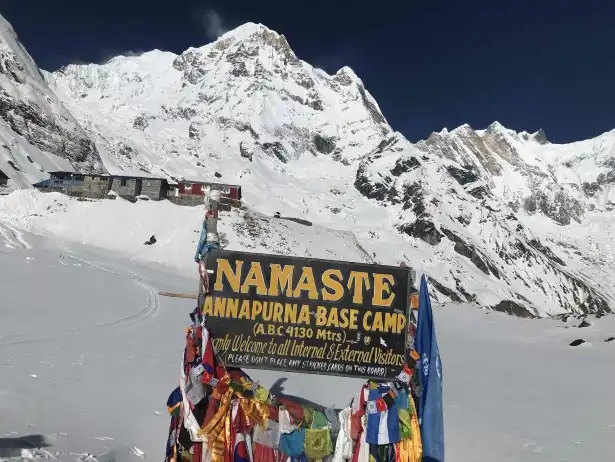
Annapurna South, 7,219 m; Machapuchare, 6,993 m-from Annapurna Base Camp (4,130 meters), thus highly rewarding the steady pace with striking vistas. It is again steeper on this leg, with some rocky patches, where trekking poles and careful footing are helpful. Short breaks here help maintain energy and enjoyment.
Segment 3: Hilltop ( Bhanuwa) to Upper Sinuwa (2,360m) — approximately 3 km
The final stretch is moderately steep, combining forest paths with occasional stone stairs. Hiunchuli will now appear in the distance, and you'll go through peaceful village surroundings. Upper Sinuwa has teahouse accommodation for meals and rest points, which is a fitting end to the day's trek.
Highlights: Rhododendron and pine forests, Chhomrong Villages, Hinuwa, Modi Khola river, Riverside village and views of Annapurna South at 7219m, Machapuchare at 6993m, and Hiunchuli at 6441m.
Here, the cost of trekking this trail normally will be about USD 450, including guide and portering support. The cost of meals and lodging will be about USD 10–25. For beginners or those in the middle, it would be advisable to split the journey into manageable portions relating to energy, time, and acclimatization. By analyzing each section of this trail, beginning from Jhino Danda, 1780m, to Upper Sinuwa, 2,360m, it would be useful in creating an effective journey.
In other words, the way the path is segmented helps to better plan, pace, and be cautious. Annapurna trekkers benefit from the halts, sight points, and cultural engagements in between. Thus, the understanding of the distance segmentation is fundamental to a fruitful Annapurna treks journey.

Elevation Profile & Altitude Challenges to Expect
From Jhino Danda at about 1780 meters up to Upper Sinuwa at roughly 2,360 meters, the climb unfolds as a gentle ascent-around 600 meters in total. You'll move through shaded forests, along forested tracks, and across open clearings that give you wide, sweeping views of the Himalayas. Along the way, you can spot Annapurna South (7,219m), Machapuchare (6,993m), and Hiunchuli (6,441m) peeking through the landscape. Knowing this elevation arc helps you pace yourself, manage water, and plan rests.
- Quick reference: elevation profile and altitude considerations
- Jhino Danda: 1780-2,160m | 400m gain | Stone-paved, riverside | Easy; short break recommended
- Riverside Village: 2,160 - 2,260m | 100m gain | Forested, moderate slope | Easy to moderate; drink often
- Forested Hilltop/Bhanuwa: 2,260m - 2,320m | 60m gain | Rocky, inclined | Fatigue risk; steady pace advised
- Hilltop to Upper Sinuwa: 2,320m to 2,360m | 40m gain | Forest path, gentle slope | Minimal altitude risk; keep energy up
- Peaks visible: Annapurna South, Machapuchare, Hiunchuli | Scenic views; no altitude impact at observation points Note: Same message: there will be some moderate elevation gain, forested and open areas; set a good pace and hydrate, be aware of the onset of altitude symptoms.
Also, altitude trouble can appear even on mid-level elevations if you're pushing yourself hard or having finicky weather. Be prepared for possible symptoms: shortness of breath, a mild headache, or general fatigue. Gradual acclimatization and steady pacing reduce the risk of altitude sickness. Keep a steady rhythm and, when possible, pause in shaded or open spots; stay well hydrated to master these challenges.
Actually, the Jhino Danda to Upper Sinuwa route blends forested parts, stone steps, and also partial rocky stretches, adding to the overall work. Close to Upper Sinuwa, higher gradient parts ask for a good foot method and more considerate energy management. Bring proper trekking shoes, trekking poles, and layers for the weather that changes in a second. With a clear understanding of the elevation profile, you will hike with much more safety, comfort, and enjoyment.
Hike slowly, including regular breaks in your elevation gain. Local guides and porters support you in energy management and navigation skills, making it easier to ascend. Hydrating regularly and eating frequently during stops at teahouses keeps you energized as you go up through forest pathways and rocky areas. Early morning departures burn less energy and are better for unhindered, excellent views of the Himalayan giants.
In a nutshell, knowing the climb from Jhino Danda at 1780 meters up to Upper Sinuwa at 2,360 meters means safety. Go in gradual steps, pace yourself, drink enough, and listen to your body. You will treat yourself with grand panoramas of Annapurna South-7,219m, Machapuchare-6,993m, and Hiunchuli-6,441m but stay on top with elevation and finish off a rewarding Himalayan journey.

Duration & Daily Pace: Estimations of Time Needed for Each Leg
Make the intended day hike from Jhino Danda (1780m) to Upper Sinuwa (2,360m) in daily steps estimated in pace time per section.
Key duration and daily pace highlights include:
- Jhino Danda (1780m) to riverside village – 2 km, 45–60 minutes, moderate pace
- Riverside village to forested hilltop – 3 km, 90–120 minutes, use trekking poles on rocky patches
- Hilltop to Upper Sinuwa (2,360m) – 3 km, 60–90 minutes, forested path, teahouse stop
- Total distance – 8 km with elevation gain of 600 meters
- Estimated total trekking time – 3–4 hours, depending on pace, breaks, and scenery stops
- Recommended gear – trekking shoes, walking sticks, backpack, water bottle
- Highlights – panoramic views of Annapurna South (7,219m), Machapuchare (6,993m), Hiunchuli (6,441m)
From Jhino Danda, 1780 meters, head to Upper Sinuwa at 2,360 meters, having an idea of the timing and setting of a comfortable pace that will enable you not to have an overly strenuous day on the path. The route is around 8 kilometers with a gentle rise-a length most hikers can cover in one day. Knowing what a sensible daily rhythm helps keep energy management, breaks, and views of Annapurna South (7,219m), Machapuchare (6,993m), and Hiunchuli (6,441m) in check. In short, a doable time plan moves you efficiently enough without overexertion nor delay.
Actually, leg one starts at Jhino Danda (1780m) and heads up to Talekhu and to a riverside village via Chhomrong, about 2 kilometers away. This section usually takes around 60-90 minutes. The path is stone-paved, with a few small suspension bridges and plenty of streamside scenery. Teahouse stops or riverbank pauses offer rest and a chance to adjust to the gentle incline, plus some photo opportunities. Pacing this part helps you warm up properly and conserve energy for the climbs ahead.
Further, leg two from Lower Chhomrong or Riverside Village to Bhanuwa covers approximately 3 kilometers from the riverside village up to a forested hilltop; here, the trail gets steeper and rough with rocky patches at places, so trekking poles come in handy. Plan about 90–120 minutes, depending on your fitness level, route familiarity, and the number of breaks. On the way, open clearings reveal the heights of Annapurna South at 7,219 meters and Machapuchare at 6,993 meters. As challenging as it is, rewarding becomes the means upwards. For energy and acclimatization, the terrain and altitude require regulating of pace.
Finally, the final leg from the Bhanuwa to Upper Sinuwa (2,360m) is approximately 3 km with a gentle slope. It will take most trekkers around 60-90 minutes to complete this leg. At this point, there is teahouse accommodation and dining facilities that provide trekkers with ample time to rest after conquering the entire trail. On a clear day, trekkers will enjoy the sight of Hiunchuli (6,441m) and the valley below.
In conclusion, it helps to know the approximate trekking time it takes to get to the end of the legs. Trekkers will benefit from the rest and acclimatization processes that the calculation of the time from Jhino Danda (1780) to Upper Sinuwa (2,360m) will provide.
Haven Holidays Pvt. Ltd.: Trusted Support for Annapurna Region Treks
Discover Haven Holidays Pvt. Ltd., a trusted trekking partner for Annapurna region treks. Learn services, guides, and safety support offered.
The following table highlights key services provided by Haven Holidays Pvt. Ltd.:
| Service | Details | Benefits |
| Trekking Guides | Experienced, certified | Safety, trail knowledge, language support |
| Trekking Porters | Trained, reliable | Carry luggage, maintain trekking comfort |
| Permits Assistance | ACAP, TIMS, local checkposts | Hassle-free trekking, compliance with regulations |
| Accommodation & Meals | Teahouses, local cuisine | Rest, nutrition, cultural immersion |
| Transportation | Kathmandu to trailheads | Efficient, comfortable travel |
| Safety & First Aid | Emergency plans, first aid kits | Reduce risk, quick response to injuries |
| Itinerary Planning | Daily trekking, rest stops | Efficient time management, enjoyable pace |
| Custom Packages | Solo, group, family options | Personalized trekking experience, flexible schedules |
Meanwhile, Haven Holidays Pvt. Ltd. is an exemplary guide for treks in the Annapurna region, ranging from Jhino Danda (1780) to Upper Sinuwa (2,360m), and more. By opting for treks with Haven Holidays, you can focus on the sight, the excitement of the climb, and the picture opportunities for the major peaks around, such as the captivating ranges of Annapurna South (7,219m), Machapuchare (6,993m), and Hiunchuli (6,441m). It can thus be said that professional help can always add to the thrilling experience of trekking the Himalayas.
Safety, quality, and environment are the core of the services provided by Haven Holidays. The first-aid training of the guides and the familiarity with the region enable the trekkers to walk in the forest, along the rivers, and along the rocky sections with confidence. The porters take care of the luggage, thus allowing the trekkers to walk at a comfortable pace.
In fact, the Jhino Danda to Upper Sinuwa packages include a combination of accommodation and meals, along with permit organization. Haven Holidays organizes the permits for ACAP and TIMS, teahouse arrangements, and transport to the trailheads from Kathmandu (1,400m). The packages cost anywhere between $450 to $600 for the duration of the trek. The advantage for the trekker lies in the transparent pricing, explicit safety rules, and assistance provided at all times. The trek planning by Haven Holidays helps to minimize hassles and maximizes the Himalayan trek experience.
Here, Haven Holidays puts eco-friendly trekking, smart waste management, and helping local communities right at the heart of what they do. As trekkers wander the Himalayan trails, they are not just seeing the journey, but building sustainable tourism. Guides proudly share insightful knowledge about the plants and animals, or the villages' cultural heritage that line the path. This blending of expert support with a strong sense of environmental responsibility keeps the experience safe, responsible, and truly memorable.
Bottom line: Haven Holidays Pvt. Ltd. stands as a dependable partner for the trek from Jhino Danda (2,100m) up to Upper Sinuwa (2,360m). With certified guides, porters, permit handling, and solid safety measures, the adventure is enhanced in comfort and cultural immersion. Trekkers are treated to sweeping views of Annapurna South (7,219m), Machapuchare (6,993m), and Hiunchuli (6,441m) while receiving professional guidance at every stage of their Himalayan journey.
Snack Spots and Scenic Resting Spots on the Jhino Danda to Upper Sinuwa Section
Discover the best places to grab quick bite snacks and beautiful rest spots along the way as you trek from Jhino Danda (2,100m) to Upper Sinuwa (2,360m) on the Annapurna trail.
Key stops for the snack break and sight-seeing:
- Modi Khola riverside (2,120m): Rocks, shaded areas, and light refreshments
- Riverside village (2,160m): Teahouse, local tea, meals, cultural exchange
- Top of the forested hill slopes (2,260m): Clearance areas, panoramic views of Annapurna South (7,219) and Machapuchare (6,993) – suitable.
- Hilltop to upper Sinuwa (2,320m): forest trails are shaded, resting points after rocky parts, view of Hiunchuli (6,441 - Upper Sinuwa (2,360m): last teahouse stop, meals, relaxation, and mountain view.
While making way from Jhino Danda at an altitude of 1780m to Upper Sinuwa at an altitude of 2,360m, it becomes essential to pace your snack breaks. It will allow you to take short pauses while appreciating the panoramic views of Annapurna South (7,219m), Machapuchare (6,993m), and Hiunchuli (6,441m) mountains. Take short pauses at river side village or Chhomrong village, or at places where there are clearings in the forests, or at teahouses along the way, where trekkers halt to refresh themselves.
Here, the initial ideal pause is located close to Modi Khola River and hardly a kilometer from Jhino Danda (2100m). Look for a suitable perch in the rocks or bridges and enjoy the sound of water and forests. Meanwhile, snacks of nuts, chocolate, and energy bars will ensure that you stay fueled up for what comes next. In fact, there is ample opportunity for photography with mountains in the backdrop.
Further, the second major stop lies at a riverside village or Talekhu about 2-3 kilometers down the route. The teahouses available offer regional tea, snacks, or food, so you can relax indoors. Interacting among the locals enhances the cultural element during the recovery period before proceeding to the wooded peaks. The breaks combine comfort, culture, and sustenance for a safe trek.
It is essential for trekkers to include snack times every 45 to 60 minutes as part of their routine. Teahouse snacks/kaka or tea, as it is commonly called, can cost between USD 2 to 5 per item. With your own supply of energy bars, fruits, and trekking snacks, you will be well-refreshed even in those longer treks located farther away from popular destinations. Snack times can serve more purposes other than providing your energy boost.
Thus, well-placed snack points and scenic rest breaks can greatly increase the efficiency, safety, and fun factor of a trekking experience. "Rest breaks at or near river crossings, villages, and forestry clearing points, as well as Upper Sinuwa (2,360 m), provide refreshment, rest, and spectacular scenery." This equates to a steady supply of energy, enhanced hydration, and motivational levels, giving the trekker a solid foundation for embarking on a journey along the Annapurna trail safely and successfully.
Trail Hydration – Water Sources, Bottles, and Purification Advice
Stay Hydrated on Annapurna Trek. Find water sources, water bottle information, and water purification advice from Jhino Danda (1780m) to Upper Sinuwa (2,360m).
Water sources, bottles, and purification advice by location:
- Modi khola riverbank (1780m): This one is new water. Self-contained water bottle or camelbak. Water must be purified with UV or Chlorine tablets. Tip: Do not drink directly from streams.
- Riverside village (2,160m): Teahouse water taps. Carry collapsible water bottle. Filter or boil water to purify. Refill and drink water after taking a snack break.
- Ending in a forested hilltop (2,260m): Small spring. Use hydration pack. Purify with portable filter. Drink in small quantities to avoid fatigue.
- Hilltop near Upper Sinuwa (2,320 m): Village tap. Bottle refill required. Either boil or treat with chemicals. To be had as a light accompaniment to a filling snack.
- Sinuwa, Higher (2,360m): Teahouse supply only. Use bottle or cup. Must filter or drink bottled water. Hydrate before resting or staying overnight.
Meanwhile, staying hydrated goes a long way when engaging in a climb from Jhino Danda up to Upper Sinuwa, as there will be moderate elevation and physical effort involved. Ensuring that you balance fluid levels will help you stay away from fatigue, dehydration, and altitude sickness. The best approach will be to plan drinking according to the length of climb, elevation, and atmospheric conditions for the day. Proper containers, methods, and points of replenishment will go a long way for hydration along the Himalayan trails.
Along the route, there are a number of water sources, including Modi Khola streams that provide access to clean water. However, it needs to be purified for drinking. The teahouses in the villages along the rivers and on top of the forested hills, such as Upper Sinuwa Teahouse, provide bottled water. Therefore, it is advisable to have water bottles along the route to enable one to drink along the trek.
For gears, use bottle carriers, hydration packs, or foldable water flasks. Purification tools vary from UV sterilization instruments to chemical tablets and filter systems to make the water safe for drinking. You can refill from teahouses or filtered streams. Monitor the amount of water consumed in a day: around 2 to 3 liters depending on the nature of the day's activities. This will aid acclimatization, improve performance, and increase efficiency in trekking.
In fact, trekkers should monitor the color of their urine and their level of thirst as fast indicators of hydration. It's a good idea to bring spare water bottles and water purification tablets to ensure clean water is always at hand. Hydrating with light snacking can help maintain energy levels and even avoid altitude headaches. Good hydration also makes rock, forest, or exposed sections of trail more secure to walk.
Here, the important thing is that keeping your body hydrated within the range of 1780-2,360 meters above sea level is very essential for the health, stamina, and smooth trekking of the trekkers. You can stay hydrated by relying on a variety of water sources, proper purification techniques, and suitable water bottles. In turn, trekkers wind up with a safer, more comfortable, and more rewarding Himalayan journey while exploring Annapurna South at 7,219 meters, Machapuchare at 6,993 meters, and Hiunchuli at 6,441 meters. Best Places for Lunch or Tea on the Way to Sinuwa from Jhino Danda
Discover the best lunch and tea places between Jhino Danda (2,100m) and Upper Sinuwa (2,360m) with views of the Himalayas.
Key lunch and tea stops along the trail include:
- Riverside village (2,160m) – Teahouses, Nepali tea, momo, dal bhat, indoor seating, stream views
- Forested hilltop (2,260m) – Small teahouses, snacks, hot drinks, panoramic views of Annapurna South (7,219m)
- Hilltop near Upper Sinuwa (2,320m) – Shaded seating, light meals, resting spot after rocky sections, Hiunchuli (6,441m) view
- Upper Sinuwa (2,360m) – Main teahouse stop, full meals, indoor seating, panoramic Himalayan vistas
Actually, the trek from Jhino Danda to the upper Sinuwa point has several appropriate lunch and tea spots that will give you the rest and refreshment that you need. In addition to this, making appropriate lunch and tea stopovers will allow you to enjoy the sight of Annapurna South (7,219m), Machapuchare (6,993m), and Hiunchuli (6,441m) as well. This is due to the teahouses where snacks and local food are served to give the stopovers both purpose and scenic value.
First place to stop: Teahouses 2 kilometers from Jhino Danda (1780m). Here, you can find Nepali tea, momos, and dal bhat, all of which can be consumed inside. The peacefulness of having streams surrounding you, as well as trails full of lush environments, will surely be felt as you get refreshed for your next journey. Cost: Tea, snacks - 2-5 USD, meals - 5-10 USD.
Likewise, another common stop is the forests found on a hilltop that reaches an altitude of 2,260 meters. There are teahouse stalls that offer light fares, hot beverages, and breathtaking scenery of Annapurna South (7,219 meters) and Machapuchare (6,993 meters). There are also shaded areas to take a breather after taking short but physically demanding climbs. In addition to this is the interaction with the locals.
Importantly, trekkers must make it a point to have a meal break after every 2-3 kilometers of trekking, as this will help retain their energy levels. If you carry some energy bars with you, it will help you last longer until you reach some tea houses along the way. Your guides and porters will help you choose a good tea stop.
Briefly, the best restaurants for lunches and teas between Jhino Danda (1780m) and Upper Sinuwa (2,360m) provide sustenance, a break, and spectacular views. The teahouse system found in river-side villages, amidst the trees on a hilltop or two, and in Upper Sinuwa (2,360m) integrates food and culture. Care and planning in the design of rest stops enable the Annapurna trekking experience to become a safer and more rewarding one.
Toilets, Garbage Disposal & Hygiene Facilities Along Route
Learn how restrooms and waste management are handled from JhinoDanda(2,100m) to Upper Sinuwa(2,360m) during a Himalayan trek.
Here, the quick glance below outlines the key for the toilets/toilet facilities, waste disposal, and sanitary facilities provided for the route:
| Location | Altitude | Toilet Type | Waste | Tips & Tricks |
| Riverside village | 2,160m | Squat toilet | Basic pit, teahouse bins | Bring toilet paper, dispose properly, small fee |
| Tree-covered peak | 2,260m | Squat toilet | Limited, carry back trash | Use biodegradable bags, do not litter |
| Hilltop at Upper Sinuwa | 2,320m | Squat toilet, teahouse facilities | Pit toilet disposal and some trash bins | Keep clean and carry hand sanitizer |
| Upper Sinuwa | 2,360m | Flush or improved pit | Separate bins for biodegradable & non-biodegradable | Follow teahouse rules, avoid contamination |
Actually, sanitation is very important in a trek from Jhino Danda up until Upper Sinuwa. Sanitation is important because it improves your health, keeps you clean, and is ideal for the environment. It is also important for keeping you healthy and preventing diseases. Toilets in most teahouses along the hike will provide basic toilet facilities. Sanitary practices in waste disposal also vary from one place to another.
In the riverine villages, and on the forest-covered hilltops, the toilets are mostly of the squat variety, and you will need to carry your own toiletries along. Some teahouses will also charge you for use, and this will range from USD0.5-1. If you are trekking with others, you can carry the cost together and avoid the improper disposal of waste along the forest trails.
At Upper Sinuwa (2,360m), restroom facilities will be relatively better, either toilets with flushing systems or toilets with pits. Refuse disposal may involve separating food waste and other non-biodegradable materials. Guides will brief you on how to dispose of these to avoid pollution. This will help you maintain your personal hygiene while trekking.
Actually, Hygiene during trekking is based on the following principles of Leave No Trace: avoid open defecation, use biodegradable replacements, and be conscious of waste. Hand sanitizers, wet wipes, and a small waste bag on every trekker's sack make the forested or rocky stretches cleaner. Guides can again be key players in educating trekkers about local sanitation norms and environmental safeguards that may not be naturally observed. Not only does planning toilets and waste disposal in advance reduce health risks, but the Himalayan habitat also remains considerably healthier.
From Jhino Danda 1780m onwards and up to Upper Sinuwa 2,360m, toilets, waste handling, and sanitary facilities are important to ensure a safe and sustainable trek. With good preparation, the facilities of teahouses being put to good use, and responsible disposal, hygiene is maintained, contamination avoided, and it is ecofriendly tourism. That means trekkers will have a healthy, comfortable, environmentally friendly tour in the Annapurna region.
Accommodation Options at Upper Sinuwa: Teahouses & Comfort Levels
Explore accommodation options at Upper Sinuwa (2,360m) with teahouses, comfort levels, amenities, and Himalayan trekking stay experiences.
Key accommodation options at Upper Sinuwa (2,360m) include:
- Basic rooms – shared bathrooms, bedding, blankets, budget-friendly, USD 5–7 per night.
- Standard rooms – twin/triple, blankets, wooden furniture, shared facilities, USD 7–9 per night.
- Upgraded rooms – attached bathroom, hot water, private seating, USD 10–12 per night.
- Teahouse dining areas – meals, tea, snacks, indoor seating, panoramic mountain views.
- Common areas – resting space, social interaction, information on trekking segments.
Here, the altitude of Upper Sinuwa reaches approximately 2,360 meters. The place provides a welcoming teahouse atmosphere for trekkers on the Annapurna trail. The accommodation available varies from basic to shared bathrooms and better facilities with private restrooms. Trekkers can look forward to warm bedding, comfortable blankets, and the majestic Himalayan range including Annapurna South, Machapuchare, and Hiunchuli mountains.
In most teahouses, there are twin or triple-bedded rooms with simple beds and common toilets. Each room is equipped with beds and wooden furniture. Before sleeping in these teahouses, trekkers and climbers need to pay a fee that falls in between USD 5-10. In most cases, hiring a guide or a porter will make check-in and carryout of bags very simple. Selecting teahouses depending on their level of comfort will facilitate sound sleeping and preparation for a day of trekking.
Further, some teahouses have deluxe facilities consisting of attached bathrooms, hot water, and private sitting sections. This makes such facilities ideal for trek members who require greater comfort or those trekking with families. The teahouses offer a dinning section for eating meals, taking refreshments, and relaxing after a day of toil. The use of such facilities helps trek members to regain strength exerted by gaining altitudinal and difficult trek routes while enjoying the beautiful Himalayan atmosphere.
In fact, tea house sites along the pass are more than where trekkers can sleep. These are equipped with electricity, charging stations, or lounging areas where trekkers can socialize. Some of these sites have Wi-Fi, although this should not be expected to be connection speed or dependability. Guides recommend that rooms should be booked ahead, especially when trekking during peak seasons, should you want to catch a glimpse of Annapurna South (7,219m) or Machapuchare (6,993m). Understanding what’s on offer will enable you to maintain safety, comfort, and the ability to conserve your energy.
Overall, the teahouses in Upper Sinuwa (2,360m) offer something for everyone, ranging from no-frills to a bit more deluxe. While organizing overnight stays, it's essential to weigh your comfort level against your financial costs and the corresponding amenities provided for a good night's sleep and recovery. By this, it's achievable for trekkers to enjoy the Himalayas, hospitality, and accommodations for a successful and safe trekking adventure.
Food & Meal Choices: Dal Bhat, Snacks & Dietary Tips
The following are the things to eat from Jhino Danda to Upper Sinuwara (1780m to 2,360m). Also, learn more about dal bhat, other snacks, and some tips.
The following is a quick rundown of what they normally choose by spot:
- Riverside village (2,160m): Dal bhat, momo, tea, and noodles. Tip: Eat light and drink plenty of water. Cost: Meals will cost around USD 5-8.
- Forested hilltop (2,260m): Snacks, hot drinks, meals. Tips: Eat small meals often; snack on energy-rich foods. Cost: Items range from $2 to $5.
- Hilltop before Upper Sinuwa (2,320m): Soup, Tea, Energy Bars. Tip: Mix and match carbs and protein sources. Price: Around 3-6 USD each.
- Upper Sinuwa (2,360m): Dal bhat, pasta, tea, soup, snacks. Tip: Stay hydrated, and have a good mix of carbohydrates and proteins in your meal. Budget: 5-10 USD per meal.
Here, a good meal sustains the climb from Jhino Danda (1780) to Upper Sinuwa (2,360m) and ensures that energy levels, strength, and fluid management remain under control. Teahouse owners here offer dal bhat, noodles, soups, and other snacks that boost enough to sustain the body through the mountain climb. Understanding how to prepare and consume food, the proportions of the food to be eaten, and some tips related to the same will go a long way in preventing fatigue and other complications.
Actually, you can have lunch at Jhino Danda or ca nhave at Chhomrong after ascending via Talekhu. Or also can have lunch at Riverside cillage after you cross the Chhomrong river(Khola). Chhomrong is a cool village with modern facilities like coffee shop, local handicrafts, massage facility etc.
Meanwhile, good foods in the Annapurna Base Camp Trek is represented in the form of dal bhat, which is the staple diet of Nepal. In the teahouse system, unlimited servings of rice, lentils, vegetables, and meat are provided. These items provide the necessary protein sources in the body to give trekkers the energy they need in the forests and rocky areas as a result of trekking.
In between the meals, take energy bars, nuts, chocolate, or biscuits. You have the option to get the food items from the river-side villages or purchase from the top of the forest-covered hills or have them from home. Hot liquids such as Nepali tea, coffee, or soup are ideal to have if you want to warm up during the climb.
Mainly, trekkers following specialized diets can request vegetarian and vegan meals at almost every teahouse they visit. Proper hydration, coupled with the practice of consuming smaller meals, will help trekkers steer clear of altitude-related stomach problems. "Eating and taking snacks at intervals of every 2-3 kilometers can help maintain our energy and strength," their trek guides recommend, thereby necessitating proper planning regarding the ingestion of food, snacks, and liquids.
In summary, the bottom line is that for a trek like the one between Jhino Danda (1780m) and Upper Sinuwa (2,360m), all that one can hope for is that dal bhat, snacks, hot drinks, and soup options are available. Food planning that takes all these needs into consideration, portion control, and hydration are the keys to maintaining trekking performance and a smooth adaptation to high altitudes. The good news is that a safe and enjoyable trek can indeed be achieved amidst the Himalayan scenery.
Mobile Network & Connectivity: What Works Where
This post will explore the mobile signal from Jhino Danda (2,100m) to upper Sinuwa (2,360m) in some detail.
Key areas to be aware of in terms of mobile phone coverage on your route:
- Jhino Danda (2,100m): limited signal, pre-check SIM, offline maps recommended.
- Riverside village (2,160m): generally good coverage from Ncell and Nepal Telecom; Wi-Fi possible in teahouse.
- Forested hilltop (2,260m): no signal; offline navigation; emergency calls only.
- Hilltop at Upper Sinuwa (2,320m): spotty connectivity; power bank recommended; data connectivity could be viable.
- Upper Sinuwa (2,360m): Good reception at teahouses, hotspot Wi-Fi at select locations, share photos.
When trekking the trail from Jhino Danda to Upper Sinuwa, cell phone reception is intermittent. With some planning, you can stay in touch when it counts. Having a sense of where you can look for cellular availability, the SIM cards that work best, and where Wi-Fi hotspots are to be found will help you stay in touch while trekking. The main carriers, Ncell and Nepal Telecom, extend cell phone coverage around the village and ridge-tops, though it’s wise to have a plan to locate hotspots where you can place a call, contact the emergency services, or use a mapping program to guide you.
Here, the first good signaling point will be, or will tend to be, at the villages by the river at around 1780m, where both Ncell as well as Nepal Telecom will be available. Here, you can place calls, send texts, as well as access data for map directions or weather updates. Additionally, some of the teahouses will also offer Wi-Fi internet, which will grant you a brief online access opportunity.
In the forested hilltop area at around 2,260m, connectivity becomes more fragmented. Then there are service disruptions and limited data access, mainly on the higher points or meadows. Its always handy to download the map apps, weather apps, and trekking guides offline, and to carry an external power bank with you to maintain the connection for emergency or photo ops of Annapurna South (7,219m), Machapuchre (6,993m), and Hiunchuli (6,441m).
When trekking from Jhino Danda to Upper Sinuwa, it is a great idea to factor in options such as dual SIMs, roaming, or prepaid services when staying in contact all the time. Making sure your electronics are constantly fueled with a portable power bank will also ensure you are in contact in the event of an emergency. It has been recommended to ensure the teahouse proprietors or other trekkers are aware of your approximate times of arrival to improve trekkers’ security.
In sum, cellular network availability from Jhino Danda (1780m) to Upper Sinuwa (2,360m) is from reliable hotspots to areas of intermittent reception. Using either Ncell or Nepal Telecom, you can depend on offline maps, portable power banks, or tea house Wi-Fi. In this way, you can remain connected, safe, and updated as you enjoy your majestic vistas of the Himalayas.
Safety Tips & Trail Etiquette for Jhino Danda to Upper Sinuwa
Safety advice and hiking etiquette for the hike from Jhino Danda (1780m) to Upper Sinuwa (2,360m) to ensure safe Annapurna expeditions.
Some of the most important safety tips and etiquette rules along this route include:
| Aspect | Recommendation | Benefits |
| Walking Pace | Moderate speed with regular breaks | Avoids fatigue and problems associated with high altitudes. |
| Gear & Safety | Trecking shoes and poles, First aid kit | Prevents slips and emergencies. |
| Hydration & Nutrition | Bring water, snacks, electrolyte drinks | Maintains energy levels, prevents dehydration. |
| Environmental Care | Pack out trash, follow Leave No Trace principles | Preserves scenery, prevents pollution. |
| Local Respect | Get permission for photos, speak softly, and respect customs | Helps the photographer win the respect of the villagers. |
| Trail Sharing | Yield to uphillers; queue in an orderly fashion | Makes movement smooth and safe. |
| EMERGENCY PLANNING | Know local teahouse areas and signal zones | Facilitates rapid assistance in emergency situations resulting in injury. |
Meanwhile, a trek from Jhino Danda (1780m) to Upper Sinuwa (2,360m) requires proper safety practice and trekker courtesy to make the experience as smooth as possible. Following proper safety procedures, respecting local cultures, and being eco-friendly ensures safety of the trekkers as well as the trails of the Himalayas. Awareness about the affect of altitude, climate, and responsible trekking on both safety and cultural sensitivities makes planning the most crucial part of any trekking experience.
Here, it is advised to maintain a steady speed, take frequent rest breaks, and remain hydrated to avoid altitude sickness, tiredness, and injuries. Trekking with solid trekking boots, trekking poles, and a first-aid kit can ensure a decreased risk of slipping or accidents while trekking through rocky and steep terrain. Taking necessary precautions to avoid encounters with wild animals and taking care to leave little to no trash can help conserve the environment.
Further, trail etiquette entails respect for residents, cultures, and teahouses. Whispering, refraining from photo shooting without consent, or queuing at narrow trails or bridges display considerate behavior. Acting responsibly regarding trash or sanitation habits portrays consideration for both natural and cultural environment. Displaying trail etiquette improves relations with residents, thereby making the entire hiking process better.
In fact, this includes watching the weather, packing extra layers, and adjusting as you gain or lose altitude. Guides instruct trekkers to keep their group informed of any route changes, where you will stop each day, and your estimated arrival time. Treating the wildlife and delicate plants with care minimizes the impacts with the surroundings. Put together, safety and etiquette make for an enjoyable, safe, and environmentally conscious trek.
Most importantly, follow safety tips and trail manners from Jhino Danda to Upper Sinuwa in order to take care of yourself, the trail itself, and show respect for local culture. With proper pacing on a trek, adequate hydration, proper gear, and avoiding harm to the environment, one can keep trekking safe and responsible. In this way, it is possible to enjoy views of Annapurna South at 7,219 meters, Machapuchare at 6,993 meters, and Hiunchuli at 6,441 meters while focusing on safety and respect during the journey.
Jhino Danda to Upper Sinuwa Trek Challenges & How to Overcome Them
Explore the key challenges of trekking from Jhino Danda (1780m) to Upper Sinuwa (2,360m) and expert tips to overcome them.
Important issues and fixes on the route:
- Altitude factors (Jhino Danda 1780m to Upper Sinuwa 2,360m): Take it easy, drink lots of fluids, eat energy
- Changeable weather: Dress in layers, use waterproofing, monitor the forecast
- Rocky and irregular stretches : Use trekking poles, wear sturdy footwear, tread cautiously
- Fatigue: Take plenty of breaks. Keep energy snacks in backpack or pockets. Stay hydrated
- Navigation: Offline maps, local guide, trail markers
Meanwhile, the trekking trail from Jhino Danda to Upper Sinuwa, a distance of 1780m to 2,360m, is more than a hill trek—it encompasses the use of the body, the elements, and planning that each trekker must look forward to. As you know the do’s and don’ts of the trail, you can manage the trek properly to avoid the hurdles that lie ahead. These hurdles include the struggles of acclimatization, increased ascents, rugged terrain, and meteorological conditions.
Here, the altitude could be a problem, and this becomes even truer as you approach the Upper Sinuwa point. You could experience headaches, fatigue, or breathing difficulties if you overexert yourself. The remedy? Take it easy and drink plenty of water. Relish meals such as dal bhat and snacking on churros or momos to compensate for the energy you expend climbing the hills.
Likewise, the weather can switch abruptly, and rain, fog, and cold winds can roll in quickly. It is always best to carry layered clothing, waterproof coats, and good trekking boots for comfort. Carefully monitor the weather and, as far as possible, rely on the expertise of the teahouse owners when you can. It is always a good strategy to combine the correct gear, awareness, and adaptability when it comes to the weather.
Moreover, terrain can also vary, ranging from rough mountain trails to damp forest routes, and it can make your footing uncertain at times. Trekking poles and proper pacing can help you avoid falls, and proper hiking boots are essential too. Your guide might just remind you to keep your eyes on the step you are about to take and avoid distractions when on the narrow trails.
In fact, logistical issues can often surreptitiously turn the corner on a trek—areas where the network is spotty, a scarcity of beds at teahouses, and more. To ensure that one is on track, it is always a good idea to have offline maps, a power bank that is fully charged, and some non-perishable snack items at the ready. The presence of a guide or a porter after also helps to improve safety, IQ, and the rapidness of turnarounds in case of emergencies.
In summary, bottom line: after Jhino Danda (1780m) and before reaching Upper Sinuwa (2,360m), one encounters altitude, weather variables, trail and physical exhaustion, and logistical hindrances. To negotiate it effectively and enjoy it comfortably and without any negative consequences, one just not only encounters all the hurdles at this point but also enhances the entire Himalayan experience of this trek and gets spectacular views of Annapurna South (7,219m), Machapuchare (6,993m), and Hiunchuli (6,441m).
Conclusion: Final Thoughts + What Makes Upper Sinuwa Worth the Journey
Learn why it is worth reaching the point of Upper Sinuwa (2,360m), and discover final recommendations, scenic attractions, and the advantages of trekking the Annapurna region.
Upper Sinuwa (2,360m), features of, and reasons why it is an adventure worth undertaking:
- Scenic views: Annapurna South (7,219m), Machapuchare (6,993m), Hiunchuli (6,441m).
- Teahouse Comfort: "From basic to upgraded rooms, warm bedding, indoor seating - rest, recharge, and overnight stays".
- Cultural Encounters: Village living and encounters - experience Nepali culture, traditions, and hospitality.
- Trail Variety: Rivers, forests, rocky trails, summit points - keeps the trail interesting and helps develop skills.
- Food/Nutrition: DAL Bhat. Snacks. Tea: Keeps energy levels sustained and assists in acclimatization. - Safety & Support.
- Guides, Porters, Awareness of Emergency Procedures.
- Enhanced Safety, Easy Navigation, Peace of Mind with guide and porter for emmergency.
Actually, trekking to upper Sinuwa (2360 meters)from Jhino Danda is a mix of nature appreciation, cultural interaction, and a personal feeling of accomplishment. The trek treats trekkers to breathtaking views of Annapurna South (7219 meters), Machapuchare (6993 meters), and Hiunchuli (6441 meters), making it a photographer's paradise. Teahouses, villages along the route, or resting points offer diverse experiences to trekkers. Understanding what Sinuwa trek upper is all about can act as a tool to increase motivation or preparements.
Here, this trek from Jhino to Upper Sinuwa is apt for those who seek an easy yet enthralling Himalayan adventure experience. Along the path of this trek, one comes across rhododendron forests, terraced rice fields, and meandering streams. People interaction on the way to the destination adds ethno-cultural richness to this adventure experience. Thus, for an adventure connoisseur who wants an encounter with nature’s splendor and an opportunity to interact with the local villagers' ethno-cultural richness, this is an apt adventure.
Further, teahouse accommodations, Nepali cuisine, and available food choices provide comfort and strength for the trekking days that lie ahead. Dal bhat, tea, and snacks help in the mending process, while accommodations help in the recovery and acclimatization processes at night. Organized treks using the services of experienced porters can help improve security and direction. It all makes for an easy trek for the trekker.
At 2,360m in altitude, Upper Sinuwa is an entry point that offers satisfying short hiking experience opportunities in Annapurna. The trail is not too high, which means acclimatization is manageable as many people find themselves drawn towards this trail as opposed to other destinations that are high in altitude. The trail offers both exercise and stunning views.
Taken together, the trek to Upper Sinuwa (2,360m) from Jhino is worth the scenic views of the Himalayas, the cultural experiences, the teahouse treats, and the satisfaction of the trekking achievement. With proper planning, a healthy diet, and guide support, the trek can be a Himalayan adventure to remember: a mix of adventure and nature in the Annapurna skies.
| Concerned URL | https://www.havenholidaysnepal.com/blogs/trekking-from-jhino-danda-to-upper-sinuwa |
|---|---|
| Address | |
| Source | https://www.havenholidaysnepal.com/blogs/trekking-from-jhino-danda-to-upper-sinuwa |
| Keywords | Annapurna Base Camp Trek Route |
| Target group(s) | Destinations , Businesses , Travellers , Education, Research, Consultancy , NGOs, Partnerships, Networks |
| Topics | Knowledge Networking, Training and Education , Natural Heritage & Biodiversity , Travel, Transport & Mobility |